Featured Post

Four Decades Along the Rainbow Road

Showing posts with label PFLAG. Show all posts

Wednesday, April 19, 2023

Not Every New Idea is a Good One


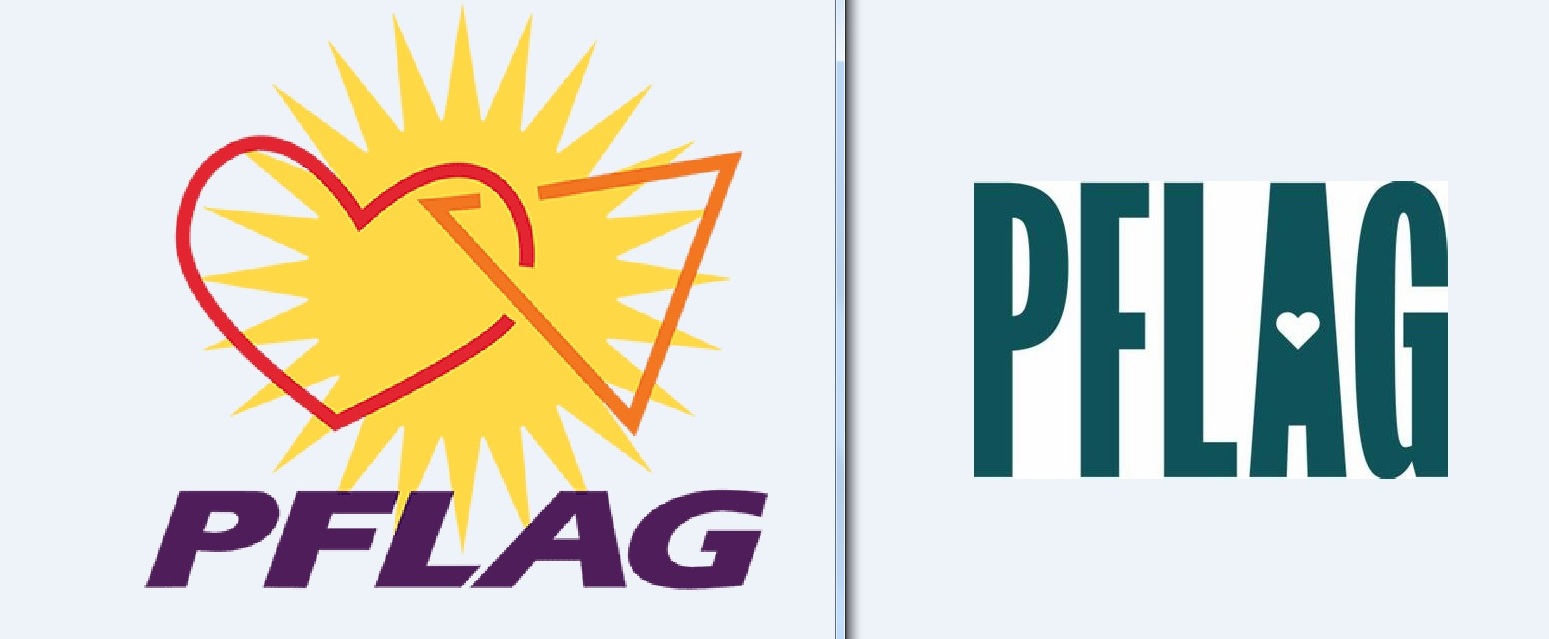
When I first saw the new PFLAG logo, I thought the person showing it to me was committing a prank. Sadly, he wasn’t. I admit that I don’t know how the decision was reached at PFLAG National to change the existing logo(left) to the new one (right); who designed this thing; how much did it cost the organization to commission the new design; and how and why PFLAG officials believe this was a good idea. All I know is that it was a ridiculous decision and an example of how to screw up branding. Moreover, all chapters must use the new edition in their communications and websites.

A logo has been essential for companies, universities, sports teams and organizations of all stripes to create a brand identity and for customers to recognize it immediately. An overwhelming majority if these entities have maintained their logos for years and in many cases, decades as they understood the critical marketing imperative of having the company readily identified with their logo.

Logos appear on official communications, signs, advertising and various types of merchandise. Rarely do these entities tinker with them. If they do, it is usually subtle and just a few minor tweaks at that. They know all too well that maintaining a consistent logo works. It surely has worked well with companies like Coca-Cola, Walmart, Delta Airlines, NBC, Kellogg’s, Colgate, NY Mets, Royal Caribbean, Ford, University of Miami, Dallas Cowboys, Detroit Red Wings and thousands of others.

LGBTQ organizations benefit from their logos as well. The Human Rights Campaign’s popular yellow equal sign on a blue field can be seen on thousands of cars’ bumpers, businesses windows, t-shirts, caps and mugs. Whatever your opinion is of HRC, you must admit they know a thing or two about branding.

But PFLAG seemed to have ignored the basics of marketing and decided to dispense with the cheerful, colorful, distinctive logo on the left in favor of the new one that screams…meh.

If I had drawn this new logo in my 7th grade art class, my teacher not only would have given me a low grade but she would have also scolded me for a lack of effort and imagination. Simply put, it is visually unappealing and simply boring.

The change does not appear to be necessary.

I am not trying to dump on PFLAG. I love the organization with its hundreds of chapters nationwide and believe it is one of the most effective organizations in the LGBTQ rights movement. For over 50 years and through its volunteers PFLAG has succeeded in keeping countless number of families together and literally saved lives in the wake of hostility and discrimination.

I have been a volunteer in multiple chapters for a better part of 20 years and have written a slew of positive articles in the LGBTQ and mainstream press touting PFLAG’s invaluable work.

Their brand and reputation have always been wonderful, and even in today’s difficult times for LGBTQ organizations, it should capitalize on that brand.

I’m pretty sure it’s too late to restore the previous logo, but hopefully decision-makers at PFLAG National will see the light nonetheless. 


Monday, June 08, 2015

Bullying Not Peanuts at Spotlighters


If there is anything wrong with Burt V. Royal’s play, Dog Sees God: Confessions of a Teenage Blockhead currently playing at the Spotlighters Theatre, it is that not enough people will catch this important work.  An “unauthorized parody” of Charles Schultz’ Peanuts comic strip whereby the Peanuts characters have grown into adolescence, Dog Sees God, which earned a GLAAD media award for Best Off-Off-Broadway Play in 1984, takes on serious issues that adolescents continue to grapple with today.  Mr. Royal’s characters’ names are different from the Peanuts crowd because of intellectual property rights.

From left: Reed DeLisle as Beethoven, Sean Dynan as CB, and Dennis Binseel as Matt
Photo: Chris Aldridge
#hocoarts
The play poignantly focuses on teen bullying, but suicide, alcohol and drug abuse, eating disorders, and sexual identity among others also factor in.  With these many issues to contend with in a one-act play lasting just over an hour and a half, time could not be spent on all to delve deeply enough to do them justice.  Nonetheless, they are touched on to some extent, and bullying and suicide emerge as the central topics.
Under Director Fuzz Roark, the talented cast of young actors brings Mr. Royal’s work to life with intensity, power and energy.  The play is constructed with over 20 scenes that are well-staged and well-paced.  The cast implements smooth transitions with the use of Al Ramer’s effective lighting design, and background music is piped in during these moments.  Many of these scenes are highly dramatic and pivotal to the plot; they are executed well.

The actors make effective use of the square stage in the center of the in-the-round theater using moveable benches and tables as props in Alan Zemia’s simple but functional set.  In addition, a piano, which plays a significant part in the play’s drama, sits in the corner along the runway.

Sean Dynan, as the principal character CB (Charlie Brown), turns in a splendid acting performance.  Handsome but conveying uncertain teenage-awkwardness at the same time, he moves about the stage with the weight of the world seemingly on his shoulders.  CB’s dog had died, and CB was looking to find out if there was an afterlife.  His friends consist of a pothead (Van, played by Adam Michael Abruzzo); two boozers who think they are the cool kids (Marcy and Tricia played convincingly by April Airriona Jones and Melanie Glickman, respectively); a sex-obsessed homophobe Matt (Dennis Binseel); and  CB’s sister who has varying philosophies on life (forcefully acted by Parker Bailey Steven), provide no good answers. 

a must-see thought-provoking and entertaining event

CB had at one time physically hurt Beethoven, the school’s outcast because he is gay, and during his attempt at reconciliation kisses him, then falls for him.  Beethoven (Schroeder in Peanuts) incurs the hateful wrath of Matt whose homophobia is so extreme that it ultimately and predictably raises questions as to why. 
 
Beethoven is played touchingly by Reed DeLisle.  He finds solace from the bullying and harassment by playing classical music on the piano.  His cowering movements around the stage and his restrained dialogue are a function of his constant fear and anger.  Mr. DeLisle delivers a moving performance in this role.
Hunky Dennis Binseel as Matt (Pig-Pen in Peanuts) is the play’s main antagonist.  His persona is similar to a ball of rubber bands tightly wound up whereby the slightest provocation sets him off.  Matt is menacing (and violent).  Mr. Binseel carries this off superbly with powerful intensity. 
Rounding out the cast is Autumn Rocha, Van’s sister, who is institutionalized for setting a red-haired girl’s hair on fire.  The scene between her and CB is outstanding.
The remainder of plot will not be divulged because the highly dramatic ending but is climaxed by an emotional letter to CB from a pen-pal.
 
To his credit, Fuzz Roark, as the Spotlighters Theatre’s Executive Director, added an insert to the program containing important information concerning bullying and suicide that had been furnished by PFLAG-Carroll County and The Trevor Project.  These pages include the warning signs that people should notice, actions that can be taken, statistics, hotline numbers and other useful information.  In addition, the lobby of the theatre displays a range of brochures covering the issues that surfaced in the play. 
Also, the brief after-play discussion by cast members with the audience caps off the experience very fittingly.  Following the performance for this review, Melanie Glickman ably led the discussion.
 
Dog Sees God is mostly a serious play with a few chuckles sprinkled about.  Mr. Royal’s script captures teenage angst and the serious problems that adolescents face at school each day.  It scrupulously informs the audience as to the consequences of bad decisions or the lack of guidance from others. 
Those critical issues covered by the play are reasons enough to attend.  However, it is a well-directed and well-staged work that is performed by a talented cast and makes it a must-see thought-provoking and entertaining event.    
 
Running time: Approximately one hour and 40 minutes with no intermission
Advisory: The play contains profanity and sexual situations and is not suitable for children under 13.
Dog Sees God runs through June 28 at the Spotlighters Theatre, 817 St. Paul St., Baltimore, MD 21202.  Tickets may be purchased by calling the box office at 410-752-1225 or visiting online.

Saturday, March 15, 2014

Taking the Local Road to Equality


As the transgender rights bill (Fairness for All Marylanders Act) continues to work its way through the General Assembly with hopefully positive results, the last big piece of legislation for LGBT Marylanders will be joining marriage equality in the rear-view mirror.  This is not to say the work is done, however. 
Carrie Evans, the executive director of Equality Maryland, indicated that there are future legislative initiatives concerning equality and justice that intersect with being LGBT.  “We are more than our sexual orientation and gender identity,” she said.  “We are black, immigrant, parents, rural dwelling, disabled, young, and senior citizens, and Equality Maryland will work on advocating for the whole of an LGBT person’s identity and issues.” 

While Equality Maryland re-tools its mission to take on matters that concern these groups, there are those who strongly believe that the most effective way to deal with anti-gay brushfires around the state is to go local.  The recent physical attack of a gay couple in New York’s West Village should underscore the fact that there are too many haters out there, which cannot be masked by recent victories in marriage and transgender equality.
Having local affiliates throughout the state, similar to what the NAACP does, makes patently good sense.  Volunteers consisting of LGBT folks and allies in each county (or region) should form groups that could be called, for example, “Equality Allegany” or “Equality Eastern Shore” or “Equality Prince George’s” depending on the jurisdiction.

With an LGBT presence at the local level, there could be more efficient ways to interact with the police on crimes or hate bias incidents directed towards LGBT folks.  Local affiliates could meet with police representatives to discuss such matters and hold conversations to educate the police on LGBT concerns that cannot be accomplished at the state level.
Local equality affiliates could also interact with their elected officials whether they are county executives, councilpersons, state representatives or other elected officials.  Maryland is a diverse state with each jurisdiction having unique problems.  Residents of these localities are familiar with these issues; perhaps they know the officials well enough to have a cup of coffee and initiate meaningful dialogue.

The same could be said for the local school boards.  Numerous LGBT families have children attending schools, and there are, of course, LGBT kids all over.  While the state has anti-bullying measures in place, individual incidents need to be addressed at the local school board level.  Who is better equipped to discuss anti-bullying policies than those people living in the same county and who may be members of the PTA or personally know members of the board?
Getting the local business community behind its LGBT neighbors cannot be overemphasized.  As the fracas in Arizona proved, business people saw discrimination as counter-productive and applied strong pressure on Governor Brewer to veto the preposterous discriminatory bill.  The local affiliate representatives should meet with business owners—large and small—to determine how supporting LGBT rights would be mutually beneficial.

I would also encourage each local group to form a speakers’ bureau consisting of at least one LGBT person, a parent of an LGBT child and another ally to foster trust and understanding.  The speakers would explain that as more and more people come out as LGBT, they are your family members, friends, classmates, neighbors and co-workers.  The presentations and discussions concerning LGBT issues should be directed at businesses, government entities and even religious organizations.  They should push to get invited; such talks would resonate given that the presenters are neighbors and customers.
Efforts at the local level have already paid dividends over the years, and there are already such “equality organizations” in place.  I’ve seen firsthand the myriad accomplishments of PFLAG-Howard County, which is a model for advocacy in the state.  The chapter has been successful at the county and state levels as well as in the private sector to eliminate the last vestiges of discrimination.

The progress being made by both The LGBT Center and the PFLAG chapter in Frederick has been notable.  They are working with the police and businesses to create a comfortable environment for a growing LGBT population in what was once a very conservative area.
There are other PFLAG chapters around the state that could serve as the root organization for the equality affiliate.  Chapters exist in Baltimore, Carroll, Kent and Montgomery counties, so they would be off to a fast start.  There has also been some movement in organizing LGBT events in Anne Arundel.

The GLCCB perhaps could serve as the principal organization in Baltimore City.  They have already taken big strides through their partnering with city government on a number of issues and have maintained a good relationship with the police—key successes in an urban environment.
Other affiliates, of course, would have to be established in rural counties.  The tasks are more daunting in those areas given the socially conservative mindset, but that is where the work is most needed.  Again, one should stress that those folks are their neighbors, customers, teachers, physicians and friends.  It’s worked before; it should work again.

All this localization is not designed to reduce Equality Maryland’s role in the quest for LGBT rights.  On the contrary, that organization could be a significant factor in the success of this effort.  I believe it should serve as the umbrella organization for the local affiliates.  Since the local groups would consist of volunteers, it would not place a financial burden on Equality Maryland.  They can use their database to identify potential volunteers around the state.
The larger organization would provide guidance on policy matters and connect the locals to elected officials.  Equality Maryland could hold an annual conference/fundraiser to discuss best practices among other subjects.  To the extent Equality Maryland would have control over the local groups would be left to the affiliates to negotiate. 

This is a big undertaking that will take time to succeed.  But going local is the right direction to take on the winding road to equality.

Saturday, June 08, 2013

Mark Patro: A Man of Pride and Passion


The battle for marriage equality in Maryland was moving into high gear by July 3rd of last year.  Polls indicated a tight contest on Question 6, creating much uncertainty and apprehension among the state’s thousands of same-sex couples and supporters who were hoping beyond hope that the bill that Governor O’Malley signed into law in March legalizing same-sex marriage would withstand a robust referendum attempt. 
While trying to combat the efforts from well-funded opponents seeking to overturn the law at the ballot box, most advocates knew it would be a struggle to prevail.  Every possible vote was needed to be harvested.  It would be particularly important to register college students, as they represent a large number of the state’s unregistered voters and, based on polling data, would more likely to be supportive.

Accordingly, on that July 3rd evening, a group of 20 folks from Baltimore and beyond gathered at the GLCCB’s edifice on Chase Street to be trained and certified as voter registration volunteers.  The instruction was to have taken place inside the building but someone didn’t get that memo; the doors were locked.  Undaunted, activist Mark Patro who was to deliver the training, held the session on the sidewalk outside the GLCCB on this particularly sultry, sweat-producing evening.  Despite that speed bump, the voter registration drive was well underway.

Mark didn’t stop there.   He bolstered the Question 6 effort by organizing Light Brigade Maryland—whereby groups of people held battery-charged lit panels that spelled out messages promoting marriage equality.  They visited over two dozen road overpasses, bridges and other venues around the state, but mostly in the Baltimore metropolitan area, to gain the attention of motorists and pedestrians.  It turned out to be a key component of the superior and creative messaging the pro-equality forces crafted during the campaign that helped sway people to vote our way.
This is what Mark Patro does.  Always forward thinking, always strategic, always creative, Mark finds a cause that is clearly progressive and manages to inspire others to reach a specific goal.  He is not a fiery, rah-rah type; in fact, he is rather soft-spoken.  But Mark possesses a lot of energy and passion, and people love to follow his brand of activism, of which he’s had considerable experience.

“My initial involvement in activism was with the impeachment of Richard Nixon; at seventeen I carried a petition for his removal from door to door in the Reisterstown suburb where I spent my teen years,” says Mark, a Towson University graduate and native of Baltimore who was educated in the Baltimore City and Baltimore County public school systems.

Mark decided to come out as gay in the late 1970's and was seeking “community” at the GLCCB. In the early 1980’s he volunteered as a photographer and worked on layout—a manual paste-up process—for the Community Center’s Gay Paper prior to the advent of computer-based page design programs. 
Light Brigade, formed by Mark Patro, in action
Mark explains that “during this period of time I got a closer look at organizing on the grassroots level when others, who were more involved than I, attempted to get an LGB housing and employment protections act through the Baltimore City Council. By the time this passed I was no longer involved with the Community Center.”

He continued his advocacy through intense letter writing to advance LGBT civil rights.  This, along with the efforts of many others, culminated with the passage of statewide protections in 2001 for gays and lesbians.
Things changed dramatically for Mark in 2005.  “I attended my first PFLAG meeting in Howard County, which was a 45 minute drive from my Baltimore County home,” he says.  “For a brief time I drove 30 minutes in the other direction to Churchville where there was a second PFLAG meeting group. While attending both meetings, I decided there was too big a gap between Columbia and Churchville and decided to start the PFLAG chapter in Lutherville.”

He remains as the president of that PFLAG chapter, and the name was changed from PFLAG-Baltimore County to PFLAG-Baltimore to reflect a broader reach.  “The PFLAG work that I’ve done is very near and dear to my heart; and the direct advocacy work that I learned how to do while working with PFLAG has become my new passion. I see my future more full of this kind of work on a broader range of issues,” Mark says.
Mark stepped up that political advocacy when passage of equal rights for same-sex couples was emerging as a top priority.  During the Maryland legislative session of 2009 he testified in favor of the Inheritance Equality bill written by Senator Rich Madaleno.  This bill passed and became law later that year.

Being one of only a handful of LGBT advocates in his northeast Baltimore County legislative district, he volunteered to become district coordinator for Equality Maryland’s annual Lobby Day. With several other dedicated district voters he made this trip for each of the last five years of that seven-year process.  
“I grew comfortable with talking to my senator and delegates to a point where I thought my conversations were sometimes having a positive impact,” Mark points out. “When the law finally passed [in 2012] and the opposition took the signed law to referendum I worked to ensure we would hold on to the right to marry.”

While the battles for marriage equality were being waged in Annapolis, Mark also turned his sights on extending protections in employment, housing and public accommodations based on gender identity and expression.  And for him, it was very significant.
“My proudest moment as an LGBT advocate happened in January 2011,” Mark explains. “This is when the Baltimore County Council passed by a 5-2 vote and amended language to the Baltimore County Code to protect people in Baltimore County on the basis of sexual orientation and gender identity. I was happy to work with a well-organized coalition of groups including PFLAG, Gender Rights Maryland, Equality Maryland, the Esimorp Network, The National Gay & Lesbian Task Force and many clergy and citizen advocates. Councilman Tom Quirk led this effort and I, for one, will be eternally grateful.”

His work with PFLAG, the legislative conversations, and the referendum work resulted in an invitation in the fall of 2012 to join the Moving Maryland Forward Network (MMFN), and in January 2013, he was invited to join the board of the Unitarian Universalist Legislative Ministries (UULM).
“As a member of PFLAG, MMFN & UULM in 2013, I am proud to have worked side by side with folks like Sharon Brackett, Matt Thorn, June Horner, Lea Gilmore, Charlie Cooper, Vinny DeMarco, Lisa Ward and Betty Crowley.”

Mark’s work seems just to be starting.  As stated earlier, his advocacy work brought on a desire to broaden the scope of issues.  “We may have passed a very strong Fire Arm Safety Act in Maryland this year but there is still work to do,” Mark reflects. “The gender identity/expression protections bill still needs to pass on the state level. I feel strongly that we need to understand and implement strong regulations, if not an outright ban on fracking.
“The simple things in our life, which are even more basic than our civil rights, are now being threatened. Labeling genetically modified food should be considered such a right. People need to be able to make a choice about what they eat and feed their children.  Fracking threatens our water supply and our ability to grow food.”

Pride…passion…and limitless issues to confront.  That’s Mark Patro.

Sunday, May 26, 2013

Scouts' (Dis)honor


Some issues are simply too thorny to resolve, especially when both sides of the ledger are entrenched in their positions.  It’s difficult, if not impossible, to reach common ground.  While they seem desirable on the surface, compromises don’t always work.  
One example that stands out is the now defunct “Don’t Ask, Don’t Tell” policy that President Clinton was forced to accept if he wanted gay and lesbian individuals to be able to legally serve in the military.  Neither advocates for gay service members nor anti-gay opponents in the military and Congress were satisfied with the deal.  It was a total flop.

Now we have another so-called compromise from the Boy Scouts of America (BSA) which once again satisfies few and disappoints many—from both sides.
On May 23, BSA by an historic vote of 61 percent of the national delegates removed the restriction denying membership to youth on the basis of sexual orientation.  But left in place was the organization’s membership policy for all adult leaders of the BSA, which means gay adult scout leaders are still banned. 

This created a situation where a gay youth could become a scout and then be forced to resign when he reaches age 18.  The message is mixed: you’re OK if you’re a gay kid, but not so when you become an adult.  Gay parents of scouts would be barred from being leaders in the organization.
Understandably, the anticipated decision not to end the ban on gay adult leaders elicited significant reactions in the LGBT community. 

PFLAG National perhaps said it best in a statement: “Inclusion, by its very nature, cannot be selective: either you are a welcoming organization or you are not. In going halfway with this policy, the BSA suggests that their members are only capable of being trustworthy, loyal, helpful, courteous and kind until their 18th birthdays. Once taught, do these traits diminish or disappear once a child comes of age? Shouldn’t being a scout serve as the best training to then lead other scouts in the future? And for same-sex parents who want to participate as leaders in their children’s troops, should the message be that their commitment to their child’s scouting activities is suspect?”
What I find appalling about the policy is the continuation of the stereotype that adult gay men are predatory and must be kept away from children. The unstated implication is that gay men have the desire to prey on minors or even recruit them to play on the gay team.  That is purely inaccurate, discriminatory and inflammatory nonsense.

The same fiction was used by opponents of President Clinton’s initial attempt to stop the ban of gays and lesbians in the military.  Remember how they instilled fear in members of Congress with the “shower” scenario?  “How can there be unit cohesion and effectiveness if openly gay soldiers took showers with their straight comrades?  How can they sleep in the same barracks?”  As we know, this fear-mongering proved to be total bunk.  The repeal of “Don’t Ask, Don’t Tell” has not caused problems within the military.
That gay men should not be allowed to be around children is preposterous.  Incidences of sexual abuse of minors are mostly perpetrated by straight individuals like relatives, clergy and even former college football coaches. 

In our society, children are around adults—gay and straight—all the time.  They are teachers, school bus drivers, pediatricians, police officers, barbers, soccer coaches—you name it.  While many of the homophobes object to openly gay adults being around kids, life goes on anyway with nary a problem.
BSA should be no different.  But religious organizations like the Mormon Church, which has a big footprint on the BSA, employs the same tired arguments and stereotyping that were frequently heard during the efforts to achieve marriage equality.  The policy that bans gay adult leaders caters to that church and other right wing religious institutions and does not make things right.

Though gay kids will now be allowed in the Scouts, the continued discrimination against gay adults would send the wrong and confusing and precarious message to the millions of young scouts—straight or gay.
“The decision to lift the ban is the first time the organization has welcomed openly gay youth — an important step in the right direction,” Ted Martin, Executive Director of Equality Pennsylvania acknowledged in a statement.  “But the Boy Scouts of America still has a long way to go before it will regain the trust of its donors, members, and the American people, a majority of which think this ban must end not only for kids, but for adults too.  Maintaining the ban on gay adults sends a dangerous message to young people that gay adults, like their friends' parents or even their teachers, can't be trusted.  By banning gay parents, the Boy Scouts are giving credence to long-debunked myths and stereotypes that promote fear, misunderstanding, discrimination, and hate.”

Eventually this policy will change.  But for now, this is just another failed attempt at compromise while BSA basically compromised itself.

Thursday, May 31, 2012

We Have Pride in June


It’s become a rite of spring.  Every mid-June going back decades, June Horner gathers her PFLAG buttons and placards from her Sykesville, Md. home and stuffs them into the already cramped trunk of her car.  She needs to move around several hundred PFLAG and safe-school pamphlets as well as other LGBT literature to allow space for the signs, which she always takes with her to the Capital Pride (Washington, D.C.) and Baltimore Pride parades. 

Typically, the sign June and her husband Graham hoist up at these events reads: “Our Kids are Fine—Just the Way They Are.”  But there are others she will employ too, depending on the event and the message she wants to convey.  Often, June can be seen at Lobby Day rallies or other parades raising the familiar “Civil Marriage is a Civil Right” placard or a “Someone You Love is Gay” bumper sticker.

June is a recognizable figure.  Usually donned in a “I’m a PFLAG Mom” tee-shirt or similar PFLAG garb, khaki shorts, a pink HRC cap or straw hat with an assortment of LGBT-related buttons, and a fanny pack, June Horner, who is in her early seventies, crams more energy in her small frame than most Generation Y folks—one of the primary groups she has been fighting for when it comes to LGBT rights and equality.

And come this June 16, she will be even more recognizable. June Horner has been named unanimously by the Baltimore Pride Committee to be the parade’s Grand Marshal—an honor that has been traditionally reserved for city leaders and pioneers in the LGBT rights movement.

“June Horner has been to every single Baltimore Pride parade,” Donald Young, Parade Committee Chair explained to me. “Her outstanding work in PFLAG and her belief that every human being should be treated equally and based on character, not on sexual orientation were the reasons June was selected.”

June is modest and humble about her numerous accomplishments, and this was no exception.  “I am pleased beyond measure or words to be chosen for this honor.”

Her work for LGBT equality began nearly three decades ago upon learning that her youngest son, Mark was gay.  “Back in 1984 we quickly became aware of the existence of a frightening, horrible amount of misunderstanding and discrimination against LGB individuals and community,” June noted.  “Transgender wasn’t even on the radar.”

She was struck by the fact that because her son is gay, he would be discriminated against and treated worse than her other children. “I felt I simply had no choice other than jump in and try to get involved to tell the world as best I could within whatever limited capacities I might have, that good people are being misunderstood and hurt and THIS HAS GOT TO STOP.  And this has been my passion and my purpose for over 25 years now… and counting.”

Realizing that families suffer from the same pain and injustice that their LGBT members experience, June discovered PFLAG—Parents, Families and Friends of Lesbians and Gays—that same year.  “The pain of parents and families who feel powerless as they watch the suffering of their LGBT loved ones is exquisite and intense,” June says.  “Any parent can attest to the feeling: ‘If I could only bear the pain for my child. If I could only make it better.’  Helplessly watching loved ones suffer somehow seems to increase the pain exponentially.” 

PFLAG is a place where parents, friends and family members are empowered to work together with the LGBT community to create change, as June put it, “one heart at a time.” Back then there were a relatively small number of chapters.  “I was inspired by the work of those who had come before me, and was emboldened (because I would not be working alone) to make a start toward creating change by doing those things that PFLAG does best—support, education and advocacy.”

June’s recollection of the AIDS crisis is profound.  “When I became involved in mid- 1980’s, ARC soon-to-be called AIDS was decimating the gay community.  Funerals were happening every week.  PFLAG families were banding together to support and attempt to be spokespersons to educate the general public.  It seemed the Federal Government was doing nothing and really didn’t care.  Those were heartbreaking and exhausting times. Thank goodness, we’ve come a long way… but still much work to be done.”

June started a PFLAG chapter in Baltimore in 1985, and it began well.  But after the first year there was a decreasing involvement from the city’s parents.  Other subsequent attempts to establish a chapter failed to catch on, so currently there is none in Baltimore.

Undaunted, PFLAG reached into the suburbs.  In 1994 June was a founding member of the Columbia-Howard County chapter that was started by Colette Roberts and Linda Linton.  And she continues to be a vital member of the chapter today.  June has been on the steering committee since its inception and currently serves as the chapter’s treasurer and librarian as well as any other function for which she feels she can help.  June is also a popular speaker before employee, community and LGBT groups. 

And she is one fierce advocate.  Always telling her story to elected officials either at Lobby Day or some other event, June consistently impresses.  She has testified in front of legislative committees in an effort to move the marriage equality bill along.  Republican Senator Allen Kittleman credits June along with other PFLAG advocates for helping him see the light in supporting marriage equality.  She was on hand to witness Governor O’Malley’s signing the bill into law in March, and she later hugged him for his efforts.

 Marching in Baltimore Pride Parade in 1986
Recognizing the need for an LGBT support group in conservative Carroll County, June along with other concerned county residents helped establish a PFLAG chapter in Westminster in 2011.  She sits on their steering committee as well.

June Horner began marching in Baltimore’s Pride Parade in 1986.  “I am truly proud of my gay son, and I was and continue to be ready to tell the world!!” she beams.  “I’m proud of every son and daughter of our fabulous community.”

She has marched in countless pride parades over the years in D.C., Baltimore, New York, San Francisco and Philadelphia.  “Marching in pride parades is the easy and fun part,” June points out.  “Not so easy but most essential is changing the law.  Old discriminatory laws needed to be changed.  New civil rights and protections need to be added.”

June acknowledges that we’ve come a long way but we’re not done yet. “Now we’re preparing for the referendum which will surely come. And we’ll be trying our best to spread the word to Vote FOR the Maryland Civil Marriage Protection Act in the November election.”

This tireless PFLAG Mom has been the quintessential ally, and the LGBT community of Baltimore and beyond should be eternally grateful as she has dedicated the past two and a half decades passionately fighting for the cause.

As we approach yet another Pride Parade, June won’t have to march this time; she can ride, right up front. 

Cheer her on!
Thursday, February 24, 2011

Thumbs Up or Thumbs Down


By Steve Charing

There is so much stuff going on in the political arena I feel like I’m all thumbs. Clearly there are good things happening, but others not so good. What else is new? To highlight some of these, I will give my thumbs up or down on the latest news affecting our community.

Thumbs Up: Let’s start with Sen. James Brochin (Baltimore County) of the Judicial Proceedings Committee. He heard testimony from over a hundred supporters and opponents of the Religious Freedom and Civil Marriage Protection Act on February 8. Although he had been opposed to marriage for same-sex couples and preferred civil unions, he did an about face and came out for full marriage equality. Why? Because the arguments presented by the opponents were mean-spirited, hateful and b.s. He had enough. They are their own worst enemy.

Thumbs Down: The Senate through the amendment process on February 23 stripped the words “Religious Freedom” from the name of the bill to the “Civil Marriage Protection Act.” This was as a result of a suggestion from Senator Anthony Muse (D-Prince George’s), a consistent opponent of marriage equality. The consequence of this change is that when the inevitable referendum takes place, the revised name of the bill will hide the fact that the bill contains religious protections, which would have perhaps mitigated some opponents’ ire.

Thumbs Up: Lobby Day on February 14 went well, benefitting from unseasonably mild weather and the buzz over the real possibility of significant legislation being passed this year. A large enthusiastic crowd attended the rally, which was well organized, and coupled with the face-to-face lobbying, hopefully effective.

Thumbs Down: Although there was a good group of speakers including lead sponsors of the two signature legislative initiatives and former Equality Maryland head Dan Furmansky, there was no strong headliner to draw even more people and really stoke the crowd. In the past Judy Shepard and Bishop Eugene Robinson were welcome additions to the Lobby Day podium.

Attorney General Gansler spoke, but conspicuously absent was Lieutenant Governor Anthony Brown who many are penciling in as Gansler’s primary opponent in the 2014 gubernatorial race. Brown had recently offered his public support for the marriage bill. And Gov. O’Malley would have also been an ideal headliner. What a statement that would have made. Did Equality Maryland invite these officials?

Thumbs Up: The Senate Judicial Proceedings Committee voted 7-4 on February 17 to move the Religious Freedom and Civil Marriage Protection Act forward. It marked the first time the bill made it out of committee and onto the Senate floor for a debate and vote unless there is a filibuster. The November elections and a restructuring of the committee to include more supporters greatly improved the chances. If it passes in the Senate, it moves to the House, which is expected to go our way.

Thumbs Down: The controversy surrounding the Gender Identity Non-Discrimination Act (see front page story) has drawn passion from both sides—those who oppose the current legislation because it does not include “public accommodations” and those who want to get something passed this year even without that provision. Some have even suggested that more emphasis has been placed on the marriage bill at the expense of the gender identity measure and others reject that notion wholeheartedly. Regardless of how one stands, the discourse, for the most part, has been ugly and personal at a time our community needs to unite—all of us—LGB and T.

Thumbs Up: The B’more Proud LGBTIA Leadership Summit held on February 12 at Hopkins was a huge success (see front page story). Logistically, it could not have run better, so kudos to the committee and organizers for doing a great job.

But more importantly, it was gratifying to see nearly 300 college students from the Baltimore-DC area come together and get involved. As polls continue to show, the younger generation will help win LGBT equality as they replace the older and more conservative voters. Observing the passion and interest and their eagerness to learn about important issues justifies my optimism.

Thumbs Up: A not well-known fact is the advocacy work of the Columbia/Howard County chapter of PFLAG. What do the following three senators in Howard County have in common? Sen. Jim Robey (a former cop), Sen. Ed Kasemeyer (who besides Howard he represents a blue collar conservative constituency in Baltimore County) and Sen. Allan Kittleman (a Republican) all opposed marriage equality at some point. Now all three are planning to vote for the bill on the Senate floor.

Representatives from the PFLAG chapter doggedly met with these senators as well as county delegates (except for anti-gay Gail Bates and Warren Miller who refused meetings) over the years. Chapter members told their stories in an effort to convince concerned legislators. It has paid off, and now all three are on board.

Thumbs Down: While this is not local and not directly affecting the LGBT community, a thumbs down to Wisconsin governor Scott Walker for his union-busting tactics. It’s a cynical attempt to weaken unions so they cannot help Democrats in future elections. Keep in mind unions have traditionally been a reliable supporter of LGBT rights.

Thumbs Down: Entertainer Justin Bieber for his comment in Rolling Stone about his views on being gay. “It's everyone's own decision to do that,” declaring that it is a choice. Um, no! Better that he listen to Lady Gaga who said, “There are some people in this world that believe being gay is a choice. It’s not a choice, we’re born this way.”

But the Biebs earned a Thumbs Up when he went on to say, “It doesn't affect me and shouldn't affect anyone else.”

www.SteveCharing.blogspot.com.

Monday, October 18, 2010

Trying to Unseat Foes of Equality


by Steve Charing


Maryland's legislative District 9A covers northern Howard County with numerous leafy neighborhoods and small businesses. Over 63,000 registered voters live in the district that includes Ellicott City. These voters are just about evenly split between the two parties with a fifth identifying themselves as Independents.

This used to be a Republican stronghold, but there have been changes in political leanings as new housing developments and jobs in the region have attracted younger professionals from the urban areas of Baltimore and Washington, D.C. who may hold a more progressive mindset.

As a result of this shift in demographics, there is a better chance now to unseat the two Republicans, Gail Bates and Warren Miller, than would have been thought possible only a few years ago.

As first-time candidates, business owner Jon Weinstein and Maryann Maher (pictured), a consultant with expertise in computer science, are challenging the two delegates in what has been described by most political pundits as an anti-incumbent election cycle. Still, it's always an uphill climb when trying to unseat incumbents, largely because of the name recognition that incumbency brings. In local elections, most voters don't focus on the issues as much as the identities and party affiliations of the candidates.

Bates has been in the legislature since 2002, and Miller has served since 2003. Both were appointed by then Governor Robert Ehrlich. They share conservative economic and social beliefs and are in lock-step in trying to thwart Governor Martin O'Malley's agenda.

They are also opponents of full LGBT equality.

Both Bates and Miller have joined forces with other far right wing legislative colleagues, such as Delegate Donald H. Dwyer, Jr., in attempting to pass, so far unsuccessfully, a constitutional amendment that would define marriage in Maryland as a union between a man and a woman.

Demonstrating that they do not possess even a semblance of open-mindedness concerning LGBT issues, neither Bates nor Miller allowed themselves to be available during "Lobby Day"—an annual effort to educate and perhaps influence legislators to embrace a more pro-LGBT point of view or to firm up existing support. LGBT folks and allies who are their constituents in 9A have tried to no avail to meet with Bates and Miller on these occasions. It was a basic snub of their constituents.

Moreover, several years ago, there was a hearing that took place at a Howard County Government building whereby constituents were permitted to testify for or against any proposed bill that may appear before the General Assembly. A sizable contingent from the Howard County chapter of PFLAG spoke on behalf of marriage equality for same-sex couples before the Howard County legislative delegation, which included Gail Bates.

One after another testified—perhaps a dozen or more—and not once did Gail Bates even extend the courtesy of providing eye contact with the speaker. Instead, her head was bowed as if she was praying, and her body language suggested that sitting in a burning car would have been a better place to be at the time.

Their legislative record confirms their repulsion towards LGBT people. In the 2009 General Assembly, Miller received a score of 0 out of 100 from Equality Maryland. Bates' score was a mere 5 out of 100.

In stark contrast, both Weinstein and Maher met with a variety of LGBT groups and attended their events. Both have been endorsed by Equality Maryland in the 2010 elections.

"Marriage equality to me is simply a matter of fairness, justice, and liberty," Maryann Maher told Baltimore OUTloud. "I know it will come one day and I would like to do my part, as a mother, citizen, and legislator, to make that happen sooner rather than later."


Maryland Attorney General Douglas Gansler, who has been a strong advocate for marriage equality and became more visible following his issuance of an opinion in February that stated that Maryland should recognize the valid marriages of same-sex couples performed in other locales, endorsed Jon Weinstein at a fundraiser several weeks ago.

Following the event in Columbia, the Baltimore Sun reported, "Gansler praised Weinstein as a 'former Republican' who has seen the light and become a 'pro-business, moderate, centrist Democrat who believes gay people should be able to get married.'"

Weinstein has been painting both Bates and Miller as Tea Partiers, and, as such, out of mainstream with the district's voters. He pounced on a published photograph that showed Miller at a Tea Party event last year wearing a t-shirt that read, "I'll keep my guns, freedom, and money. You can keep the change." Miller was also seen in the photo holding a sign that read, "Liar, Liar, Pants on Fire," presumably a swipe at President Obama.


This was brought up at a recent candidates' forum in Ellicott City. He responded by suggesting it was nothing more than "political hyperbole," which many voters think there should be less of and instead, more solutions to problems.


Weinstein feels his stance on equal rights is more suitable for the constituents of District 9A. "I believe that equality for the LGBT community is a matter of human rights," he stated. "Unlike my opponents who regularly seek to deny people their rights, I will work with people from the LGBT community in my district and around the state to find a path to full equality."


Both Jon Weinstein and Maryann Maher are seeking support from the LGBT community to help unseat Bates and Miller. Both can use donations as well as volunteer time. To help out, you may visit www.Vote4Jon.com and www.maryannmaher.com.

Saturday, June 12, 2010

We Take Pride in Our Allies


By Steve Charing


Our front page feature interview of straight collegiate athlete Hudson Taylor was intended to highlight the importance of having straight allies on our side in the quest for equality. As we celebrate Pride and reflect upon why as members of the LGBTcommunity we should be proud, one of the major reasons is the fact we have many straight friends and allies aiding our cause.

The inconvenient truth is that if we try to go it alone, we will get nowhere. Simply put, the LGBT community by itself does not have the numbers to affect the outcome of policy decision-making or alter elections. With estimates that indicate we comprise anywhere from 2 to 10 percent of the U.S. population, it is clear the math isn't there.

For us to succeed in the myriad unresolved LGBT-related issues, we must attract straight allies to bolster our numbers to influence lawmakers at all levels. Aside from Hudson Taylor who has stuck his neck out to publicly support LGBT rights and advocated for the end of homophobia in sports at the expense of losing some friendships along the way, there are many other straight folks who have also courageously taken a strong stand for equality and continue to do so.

Representative Patrick Murphy of Pennsylvania, an Iraq war veteran, spearheaded the efforts in the House of Representatives to repeal "Don't Ask, Don't Tell." Being straight and a combat veteran, Mr. Murphy possesses the credibility to persuade his colleagues that the policy as it exists is discriminatory and has hurt national security.

Closer to home, Maryland's Attorney General Douglas F. Gansler has been another true advocate for LGBT equality. In February he issued an opinion against vitriolic opposition from conservatives that allowed Maryland to recognize valid same-sex marriages performed in other jurisdictions.

The law and precedent were on his side, and Mr. Gansler could have left it at that and continued to carry out his duties. Rather, Mr. Gansler demonstrated the political courage so sorely needed by elected officials—especially Democrats—to not only be on the right side of fairness and equality but to go out and fight for it. Mr. Gansler has not just talked equality, he is trying to do something to achieve it, and he does it in a public way.

Since the opinion was issued, Mr. Gansler spoke before a number of LGBT political groups and religious and civic organizations encouraging those in attendance to keep up the fight for marriage equality. Considered a likely candidate for Governor in 2014, some pundits have speculated that Mr. Gansler is taking a huge political risk in championing this issue. Undaunted, he believes it's the right thing to do. And he could be encouraged by the fact that the recent Washington Post poll indicated that more Marylanders, by a narrow margin, support same-sex marriage than oppose it.

We expect the margin to widen by 2014 as young voters who tend to regard marriage equality as a no-brainer enter the voting pool and replace the older conservative voters. Having an increasing number of Gay-Straight Alliances in schools across the country is a major contributor towards this goal as does the GLSEN-led National Day of Silence that brings awareness to the need for safe schools and other LGBT issues.

The efforts in Maryland have also been bolstered by the Maryland Black Family Alliance—a civil rights advocacy organization consisting of mainly straight African-American individuals. This group has been highly visible and outspoken in their beliefs that marriage equality is indeed a civil right and condemns those preachers who cherry pick biblical passages to oppose LGBT equality.

Then you have the good folks in PFLAG—Parents, Families and Friends of Lesbians and Gays. Although the organization is not just for parents anymore as more and more lgbt people have hopped on board, it is the first group of straight allies to help our cause when it began in 1972. Now there are over 500 chapters in the U.S. What better ally could one hope for other than a parent of an LGBT child?

Furthermore, PFLAG has a program called Straight for Equality, which is a national outreach and education project that empowers straight allies in supporting and advocating on behalf of LGBT people. PFLAG offers the tools and strategies needed to attract more straight allies to the cause.

Added to the mix is the growing number of people in the entertainment industry who are coming out for LGBT rights. The battle over Proposition 8 in California served as a catalyst for this activism, and it hasn't waned. From the world of movies, television and music we are seeing more personalities unabashedly supporting our cause. Allies such as MSNBC's Keith Olbermann have been invaluable in the struggle to repeal DADT and advance other LGBT issues.

And let's not forget the number one ally-in-chief, President Barack Obama. While many activists have criticized him, and I believe unfairly, for not acting swiftly enough on lgbt initiatives, he has proven to be the first and only President who has not only talked the talk but in several significant instances, walked the walk. Read his Proclamation of LGBT Pride Month for a summary of the key actions the President has taken on our behalf.

We can increase our efforts to attract allies by having more LGBT folks coming out when feasible. When family members, co-workers, employers, friends and neighbors know that someone is lgbt, the odds are they will want to help secure rights for that individual. Almost immediately one can increase support exponentially just by coming out.

And education on important LGBT issues by political, religious and social justice groups is needed to garner further support in the straight community.

The wind is at our backs now. We are gaining momentum during this slow-moving battle to achieve full equality. And with more allies to give our movement a crucial boost, we will get there.

As we celebrate Pride, we should not only be proud of ourselves but also those wonderful allies, elected officials or not, who are helping us big time.

www.SteveCharing.blogspot.com.

Wednesday, April 29, 2009

Parenting a Trans Child (Special Guest Post)


By a Parent of a 15 year-old Trans Child

You have no idea
When you bring that beautiful little bundle home, you have no idea what surprises it will bring. Listen and watch and allow. Gender identity and fluidity start to show up very early. Separate sexual orientation and gender identity in your head. They are different. We saw our child’s actions as behavioral choices that needed to be addressed for his safety. We did not get that his behavior was a matter of gender identification and self-expression. And this early misunderstanding caused a great deal of pain.

It’s unfortunate that gender identity can surface right along with the terrible 2s. Because we saw much of his behavior as willful, we actively discouraged his variant self-expression, and with the full support and help of a psychologist who obviously did not understand gender identity.

By the time he was six, my happy baby had become so angry and hurt, he threatened suicide. Back to the mental health profession we went. This time he was diagnosed with anxiety. A correct diagnosis, but another missed opportunity to identify and support his gender variance.
The key is this: You cannot make your child more comfortable with one gender or another.

That’s already been done. It’s built into the brain. Designed by God. The only power you have as parents is also the most important, and that is the power to make your child feel comfortable and celebrated or embarrassed and shameful.

Get ready for preschool, bullies and well-intentioned adults
Be upfront with providers. Tell the day care manager the truth and that you expect full support. Educate those who will care for your child. Bring resources; contact
PFLAG to give a presentation. If you get resistance, find a new provider. You have more power here than you will ever have in public schools. Use it and enjoy it.

Bullies, if they haven’t already, will come out in preschool and will be an active and hurtful part of your and your child’s life, probably forever. Just as the parents of minority children teach their kids how to navigate in a world full of bigotry, you will too. From overt hate crimes to subtle, pernicious two-faced false support, you, your family and most especially your child will see it all. Do what you can to protect your child. More importantly, do what you can to prepare your child to deal with it.

If you haven’t already, you will now find adults who will attempt to "teach" your child the proper, acceptable behavior for his or her gender. This will range from frightening to punishing or even threatening. The most egregious of these well-intentioned adults are the sports coaches. They are the only adults still allowed to bully our children. Don’t tolerate it. One of the most important gifts I gave my son was lambasting a coach who was trying to "toughen him up" with verbal and emotional abuse.

Marital health and managing the great divide
If there exists a set of parents who agree on how to raise the most mainstream and conforming child, I have yet to meet them. The stress of raising a child with gender variance can and does rip families apart. One study claims 40% of trans kids are kicked out or run away. Don’t try to do this alone: PFLAG, therapy, support groups, good friends, a stiff drink once in a while. Use them all. Guard against sacrificing either your child or your marriage. You don’t have to understand or agree with your spouse. You do have to keep the child out of the middle, and you do have to treat everyone with respect and demand they do the same. A safe and nurturing childhood is a precious thing, and it must be protected. A healthy marriage is also a precious thing, something to last long after the children are grown and gone.

Schools, teachers and guidance counselors
I thank God that we have the dedicated educators and guidance counselors that work in our schools as part of the village that is raising my child. They are some of the most caring and hard-working professionals. But you have to be prepared: the system is bigger and more powerful than the individuals in it.

We found an undercurrent of bigotry painted over socially correctness. I don’t mean to be critical. I don’t think any individual has meant to be hurtful. I think we live in a binary society, and I think teachers, coaches and students don’t understand. I doubt that gender variance is part of their training. They mean well; they love kids. But until you get educated on this issue, you’ll likely do more harm than good.

Finding providers educated on gender
Telling your story. Again and again. That’s what it takes. By the time puberty came along and gender arose again in our house, we were in the hands of a wonderful therapist who recommended we see someone with experience. We had decided to put my son on puberty blockers, so I was looking for two trans-friendly providers: a psychologist and an endocrinologist.

The search was far more painful and difficult than it should have been. I started with our pediatrician, who had never encountered this before, so he wanted to learn more. That led him to the head of pediatric endocrinology at the state university medical system, who told him that my kid needed be in the care of a psychologist and a team to help him. But he could not recommend one. Nor did he offer to research to find someone.

Meanwhile, our family therapist had recommended two providers in the next city. Both were fully booked. They gave me more names of people who gave me more names. And I told my story, again and again. Finally we found a psychologist in our city, but he didn’t get teens and transition issues. Next provider was an hour away, but he had experience with trans kids. He is working out, and is helping our kid find his way through this. Then came the search for an endocrinologist. The first one, also an hour away, did not take insurance and wanted $400 for the initial consultation, with no guarantee to treat my kid. Finally I found one in our city. He charges me a $10 copay, and treats me and my son with respect.

Safety and decision-making
Get real and get there fast. The statistics are against you. Your child is at higher risk for depression, suicide, alcohol and drug abuse, violence and premature death. Your job is to make sure your kid knows how to be safe. Make sure your kid knows about hate crimes. Make sure he or she never goes out without friends near by. Alone is vulnerable. During the teen years, be so careful of parties. Be so careful of drinking. Booze makes for bad decision-making. Parties and high-testosterone sporting events need to be attended with caution. I am not saying lock your child in a closet. I am saying be careful and teach your child how to be.

Finally, hold yourself gently
Raising a child who is trans or gender variant is difficult. It’s scary. It’s more than you bargained for. It’ll likely be more than you comprehend. So please hold yourself gently. Forgive yourself for not knowing; for not understanding. Hold your spouse gently. But mostly hold your child gently, so very gently. Because the world will not, even if it’s just the world of preschool and play dates. And finally, if you are involved with a family on this journey, if you’re a teacher or an administrator or a provider, please be gentle; please be kind; please get educated. You simply have no idea how much it will mean to them.